Zero Trust for Agentic AI: Why Autonomous Systems Need the Same Security Controls as Humans

Organizations are rapidly deploying AI agents to automate tasks that previously required human effort.
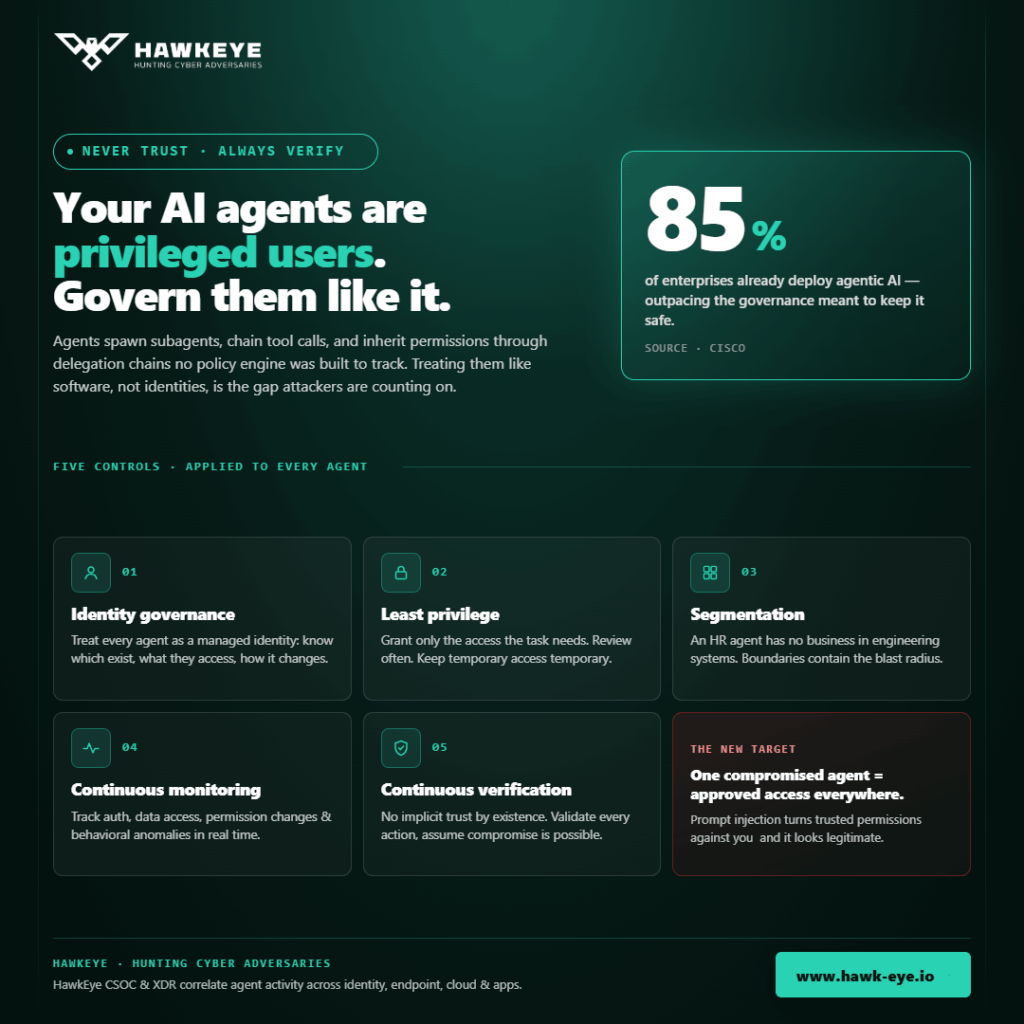
AI agents are no longer experimental curiosities sitting in sandboxed demos. They are being granted access to enterprise systems, executing multi-step tasks, calling APIs, querying databases, and making decisions without a human in the loop. According to Cisco, 85% of enterprises are already deploying agentic AI in some capacity. That adoption is outpacing the governance models meant to keep it safe.
The security problem here is structural, not superficial. Classic Zero Trust was designed with human users in mind, someone logs in, gets verified, and is granted access within defined boundaries. AI agents do not follow that pattern. They spawn subagents, chain tool calls across sessions, inherit permissions from orchestration layers, and accumulate access through delegation chains that no single policy engine was built to track. The question is no longer whether to apply Zero Trust to these systems, but how to do it in a way that actually fits how agents behave.
Why Agentic AI Breaks Traditional Access Models
Historically, organizations treated software differently from people.
Applications received permissions. Service accounts were provisioned. Integrations were approved. Once deployed, these systems often operated with limited oversight compared to human users.
Agentic AI changes that equation.
Unlike traditional software, AI agents do not simply execute predefined instructions. They interact with multiple systems, make decisions based on context, access sensitive information, and execute actions across business workflows.
An AI agent may:
- Access cloud platforms
- Retrieve customer information
- Query internal knowledge bases
- Interact with ticketing systems
- Access code repositories
- Update business applications
From a security perspective, this resembles the behavior of a privileged employee.
The difference is that an AI agent can perform these activities continuously and at machine speed.
Organizations that continue treating agents like traditional applications risk creating highly trusted identities with broad access and limited governance.
The Core Principle of Zero Trust
Zero Trust is built on a simple concept: Never trust. Always verify.
The model assumes that no user, device, application, or identity should receive implicit trust simply because it exists within the organization.
Access must be validated continuously.
For years, this principle focused primarily on human users.
Agentic AI expands the scope.
Every AI agent should be treated as an identity that requires verification, monitoring, and access controls similar to those applied to employees and administrators.
The question is no longer whether a user should be trusted.
The question becomes whether an autonomous system should be trusted.
The answer should be the same.
AI Agents Are Becoming High-Value Targets
Attackers increasingly view AI agents as attractive targets. The reason is straightforward. A compromised employee account may provide access to a limited set of systems. A compromised AI agent may already have approved access across multiple platforms.
Many agents maintain connections to:
- Cloud services
- SaaS applications
- Internal databases
- Collaboration platforms
- Knowledge repositories
- Business process automation tools
The broader the integration footprint, the greater the potential impact.
Instead of stealing credentials across multiple systems, attackers may focus on influencing or abusing a single agent that already possesses those permissions.
This shifts the attack surface significantly.
Prompt Injection Changes the Threat Model
One of the most discussed risks surrounding agentic AI is prompt injection. Attackers embed instructions within content that an agent is designed to process. Documents, emails, web pages, support tickets, and knowledge repositories can all become delivery mechanisms. If successful, the agent may perform actions that align with attacker objectives rather than organizational intent.
Traditional security controls often struggle with this scenario because the activity appears legitimate. The agent is using approved permissions, accessing authorized systems, and executing tasks it was designed to perform. The issue lies in how those tasks are being directed rather than the actions themselves.
Zero Trust assumes that compromise is possible and focuses on limiting the consequences when it occurs. That philosophy applies directly to agentic AI.
Identity Governance Becomes Critical
One of the biggest mistakes organizations make is deploying AI agents without integrating them into identity governance programs.
Many enterprises maintain rigorous oversight for employees while machine identities operate with far less scrutiny.
This creates visibility gaps.
Security teams need to know:
- Which agents exist
- What systems they can access
- Which permissions they hold
- What actions they can perform
- How their access changes over time
Without this visibility, governance becomes difficult.
The first step toward Zero Trust for agentic AI is treating every agent as a managed identity rather than a software component.
Least Privilege Matters More Than Ever
Many AI agents receive broad permissions during deployment.
This often happens because it simplifies implementation and reduces operational friction.
Over time, those permissions accumulate.
An agent originally deployed for a narrow task may gain access to multiple systems, data repositories, and workflows as new capabilities are added.
This creates unnecessary exposure.
Zero Trust principles require strict enforcement of least privilege.
Agents should receive only the access required for their specific function. Permissions should be reviewed regularly. Temporary access should remain temporary.
The goal is reducing the blast radius if an agent becomes compromised or manipulated.
Segmentation Limits Agent Movement
Organizations learned long ago that unrestricted movement across environments creates risk.
The same lesson applies to AI agents.
An HR-focused agent should not communicate freely with engineering systems. A support agent should not maintain unrestricted access to financial applications. A security operations assistant should not automatically gain access to every business platform.
Segmentation helps contain risk.
When agents operate within clearly defined boundaries, the impact of compromise remains limited.
This principle aligns closely with Zero Trust architectures already used across user, device, and application security programs.
Monitoring Agent Behavior
Visibility remains one of the most important components of Zero Trust.
Organizations need to monitor AI agents with the same level of attention applied to privileged users.
That includes tracking:
- Authentication activity
- Data access patterns
- System interactions
- Permission changes
- Workflow execution
- Behavioral anomalies
This is where security operations platforms become increasingly important.
Capabilities such as those provided through HawkEye CSOC and XDR help organizations correlate activity across identities, endpoints, cloud environments, and applications to identify suspicious behavior more effectively.
As AI agents become more common, that visibility becomes essential.
The Future of Security Includes Non-Human Identities
The number of machine identities in enterprise environments already exceeds the number of human users in many organizations.
Agentic AI will accelerate this trend dramatically.
Security strategies built entirely around human behavior will become increasingly insufficient as autonomous systems assume larger operational roles.
Organizations are no longer securing only people.
They are securing identities, regardless of whether those identities belong to employees, applications, service accounts, or AI agents.
Solutions such as HawkEye AI are part of this broader evolution, helping security teams improve visibility and operational awareness as environments become more complex.
Conclusion
Agentic AI introduces a new category of privileged identity into enterprise environments.
These systems can access sensitive information, interact with critical applications, and make decisions that directly affect business operations. As their role expands, traditional trust models become increasingly difficult to justify.
Zero Trust provides a framework for managing this challenge.
By applying identity governance, least privilege, segmentation, continuous monitoring, and verification principles to AI agents, organizations can reduce risk while continuing to benefit from automation.
The future of enterprise security will not be defined solely by how well organizations protect human users.
It will also depend on how effectively they govern the growing population of autonomous systems operating alongside them.