AI-Assisted Cyber Attacks: How Autonomous Operations Became the New Normal

The attack cycle has fundamentally changed. Not gradually, not theoretically measurable, and within the last twelve months. IBM’s 2026 X-Force Threat Intelligence Index, corroborated by Unit 42, Google Cloud’s Mandiant M-Trends 2026, and Rapid7’s 2026 Global Threat Landscape Report, all point to the same conclusion: AI has moved past augmenting attacker productivity and into enabling autonomous attack operations at a scale and speed that existing security programs were not built to handle.
The question for security leaders is no longer whether AI-assisted attacks are a credible concern. It is whether their teams are structured to defend against an adversary that never sleeps, never makes typographical errors in phishing emails, and can begin scanning for a vulnerability within 15 minutes of its public disclosure.
Autonomous Operations Are No Longer Theoretical
Unit 42 has documented threat actors initiating vulnerability scans within 15 minutes of CVE publication. That is not a human-driven workflow, it is an automated pipeline, and it signals that the concept of a “patch window” has been rendered functionally obsolete for any organization that does not already have continuous exposure management in place.
More revealing still is the case of a documented Chinese-backed threat group that used an AI agent to orchestrate 80–90% of each attack operation autonomously. The human actors defined the objective. The agent executed reconnaissance, exploitation, lateral movement, and data exfiltration without requiring step-by-step direction. This represents a structural change in how sophisticated threat actors operate one that shifts the burden of speed almost entirely onto the defender.
ISACA’s research adds a layer that is particularly difficult for traditional threat intelligence to address: AI-driven ransomware is enabling the formation of small, transient threat groups that operate at low volume and dissolve before analysts can establish attribution. These groups do not need a sustained infrastructure or a recognizable signature. They run one or two operations, collect, and disappear a model that is specifically designed to defeat the playbooks most SOC teams have built their detection logic around.
The Data Reflects a Structural Shift
The Rapid7 2026 Global Threat Landscape Report puts confirmed exploitation of newly disclosed CVSS 7–10 vulnerabilities at a 105% year-over-year increase. The median time from public disclosure to inclusion in CISA’s Known Exploited Vulnerabilities catalogue dropped from 8.5 days to 5.0 days. Mandiant’s M-Trends 2026 goes further: 28.3% of CVEs are now exploited within 24 hours of disclosure, and in a growing number of cases, working exploits are circulating before a patch is even available.
Against that backdrop, the Edgescan 2025 Vulnerability Statistics Report found that the average time to remediate a high- or critical-severity CVE in enterprise environments remains 74 days. Forty-five percent of vulnerabilities in organizations with over 1,000 employees are never remediated at all. The arithmetic here is unforgiving: defenders are operating on a timeline that has not compressed at anywhere near the rate the attack cycle has.
Malicious packages discovered in public repositories grew from 55,000 in 2022 to 454,600 by the end of 2025, a trajectory that correlates directly with the release of GPT-4 in 2023 and the mainstream adoption of agentic coding platforms in 2025. These tools did not create malicious intent. They eliminated the technical friction that previously kept the barrier to entry high.
Cybercrime Has Professionalized
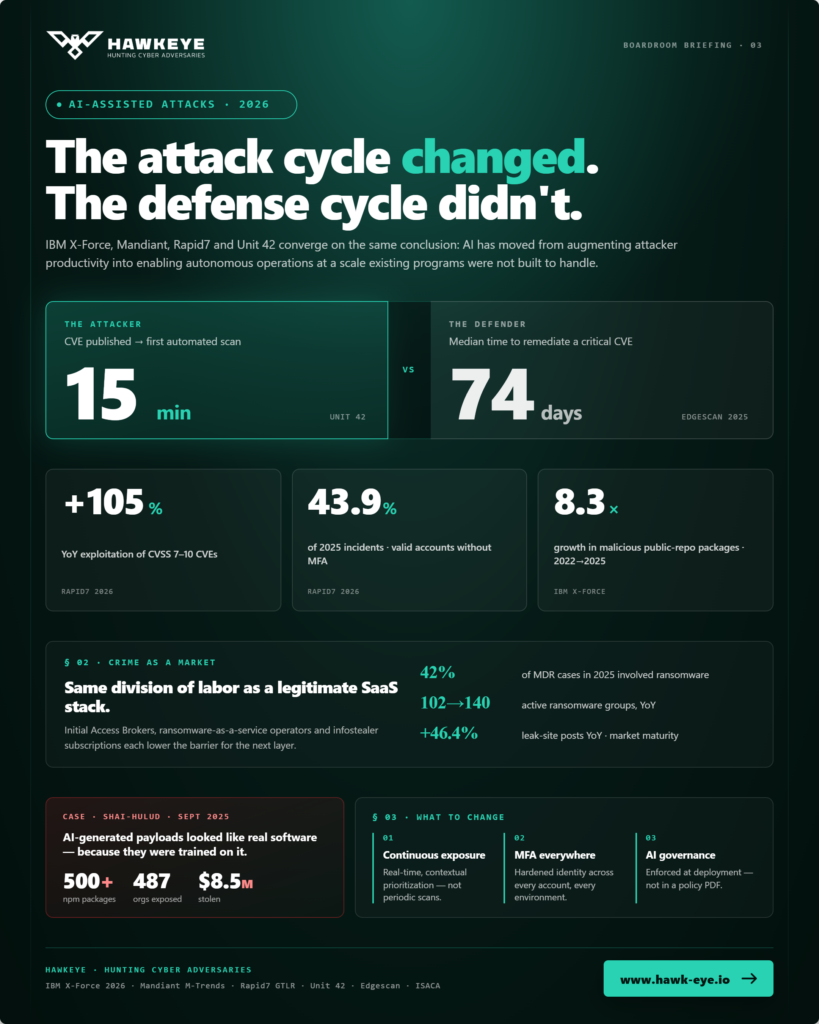
One of the more consequential developments in 2025 was the completion of a transition that has been underway for several years: cybercrime operating as a structured, specialized market. The underground economy now functions with the same division of labor seen in legitimate SaaS ecosystems. Initial Access Brokers acquire and validate network footholds, then sell them. Ransomware operators license out encryption-and-extortion toolkits. Infostealer services offer subscription access to continuously refreshed credential logs.
Each layer lowers the barrier to entry for the next. A threat actor does not need to know how to breach a network if access is available for purchase. They do not need to build ransomware if it can be rented. Rapid7’s data shows ransomware present in 42% of its MDR investigations in 2025, with active ransomware groups growing from 102 to 140 and leak posts increasing 46.4% year-over-year. That growth reflects market maturity, not opportunism.
AI sits at the foundation of this professionalization. It compresses the time between initial research and deployment, enables higher-quality social engineering at scale, and allows smaller groups to operate with a level of sophistication previously associated only with well-resourced, coordinated teams.
Authentication Is the Primary Battleground
As organizations have extended operations across cloud platforms, SaaS environments, APIs, and distributed workforces, authentication has become the control layer of the entire enterprise. Attackers have recognized this before most defenders adjusted their posture accordingly.
Rapid7’s 2026 report found that valid accounts without multi-factor authentication accounted for 43.9% of incidents in 2025. Attackers are not forcing entry, they are logging in. AI has sharpened this vector considerably: phishing campaigns documented throughout 2025 were measurably more personalized, better researched, and more contextually accurate than those of prior years, the direct result of AI conducting open-source intelligence collection at scale and generating targeted content that passes the scrutiny of individual recipients.
This is also where continuous identity monitoring becomes a non-negotiable capability. When attackers are moving at machine speed and prioritizing authentication flows over perimeter attacks, security teams need real-time anomaly detection across identity systems, not periodic reviews or reactive investigation after a credential has already been weaponized.
AI Platforms Are Themselves a Target
The same AI infrastructure organizations are deploying to improve productivity is inheriting well-documented weaknesses. Model servers, orchestration frameworks, and token-based integrations are appearing in Rapid7’s data with unsafe deserialization vulnerabilities, insufficient authentication controls, and governance gaps that create exploitable pathways into sensitive systems.
The September 2025 Shai-Hulud attack on the npm ecosystem illustrates the detection problem at its sharpest. Attackers compromised over 500 packages. The malicious code, likely AI-generated, was structurally indistinguishable from legitimate software. It included documentation, unit tests, and telemetry module formatting that defeated static analysis and signature-based scanners entirely. More than 487 organizations had secrets compromised. $8.5 million was stolen from Trust Wallet after exposed credentials were used to poison its Chrome extension.
The core issue is that AI-generated malware looks like real software because it was trained on real software. Detection tooling built for human-written malicious code is not calibrated for this.
What Security Programs Need to Change
Speed, on its own, is not a viable defense strategy when the adversary is operating autonomously and the exploitation window for a critical CVE can be measured in hours. Security programs built around reactive remediation, patch management queues, scheduled scans, and incident-triggered reviews are structurally misaligned with the current attack cadence.
The practical shift is toward eliminating categories of exposure before they can be operationalized. That requires continuous exposure visibility with contextual prioritization rather than periodic scans. It requires MFA enforcement and hardened identity controls across every environment, not selectively applied to high-value accounts. It requires governance frameworks for AI systems that are enforced at deployment, not documented afterward.
Organizations that are serious about getting ahead of this are investing in purpose-built threat intelligence platforms that provide the kind of contextual, real-time visibility needed to prioritize what attackers are actually targeting, not just what is theoretically vulnerable according to a CVSS score.
The underlying weaknesses that most breaches trace back to have not changed dramatically: weak credentials, exposed services, unpatched edge infrastructure, and insufficient monitoring. What has changed is the speed and precision with which those weaknesses are identified and acted upon. The organizations best positioned to manage that reality will be those that stopped measuring success by how quickly they can respond, and started measuring it by how much attack surface they have permanently removed.