Sovereign AI SOC in Saudi Arabia: How HawkEye Supports Air-Gapped and High-Security Operations

Saudi security teams are being asked to use AI without giving up control of the data their SOC depends on.
That becomes difficult when security operations involve sensitive telemetry, internal infrastructure records, identity activity, investigation evidence, or systems that cannot communicate freely with external services. A public AI endpoint may be acceptable for one organization and completely unsuitable for another.
This is where sovereign AI SOC architecture matters: AI-assisted investigation can operate within tighter technical boundaries while the organization retains control over telemetry, model access, agent permissions, and response decisions.
For DTS Solution, this is also where HawkEye AI SOC becomes central. HawkEye combines AI-driven triage, investigation, threat intelligence, correlation, and response coordination with human approval for high-impact actions.
Sovereign AI SOC Is About Operational Control
Sovereignty should not be reduced to where a server is hosted.
A SOC needs to know where inference occurs, whether security telemetry leaves the approved environment, which models process that information, what those models can access, and whether an external provider retains investigation data.
The sensitivity of SOC telemetry makes those questions important. A single investigation may expose usernames, internal IP addresses, endpoint activity, authentication failures, asset details, vulnerabilities, malware indicators, and information about security controls.
Saudi organizations also operate under NCA requirements covering areas such as data protection and cloud security. The NCA’s Cloud Cybersecurity Controls establish minimum cybersecurity requirements for cloud service providers and tenants, while the Data Cybersecurity Controls address protection across the data lifecycle.
A sovereign AI SOC therefore needs to match the organization’s classification, regulatory obligations, and risk model.
HawkEye AI SOC Starts With Every Alert
The operational problem HawkEye addresses is simple: traditional SOC teams can receive thousands of alerts while analysts spend large parts of their day repeating the same investigative steps.
HawkEye changes that workflow.
Its Agentic AI SOC is designed to process alerts through specialized AI functions rather than dropping everything into one general-purpose assistant. HawkEye’s current architecture uses five specialized agents that triage, enrich, investigate, summarize, and prepare response actions, with reasoning traces and analyst approval built into the workflow.
The process begins by enriching alerts with threat intelligence, behavioral context, and historical activity. Related events are then correlated across available telemetry so the SOC can work from a higher-confidence incident instead of several disconnected alerts.
Investigation follows automatically: logs, identity activity, endpoint behavior, network connections, asset context, and related indicators can be examined before the case reaches an analyst.
This is where investigation time drops. Work that may require roughly 30 minutes of manual analyst effort can be compressed to under three minutes when enrichment, correlation, investigation, and case preparation are handled as one workflow.
Five AI Functions, One Investigation Chain
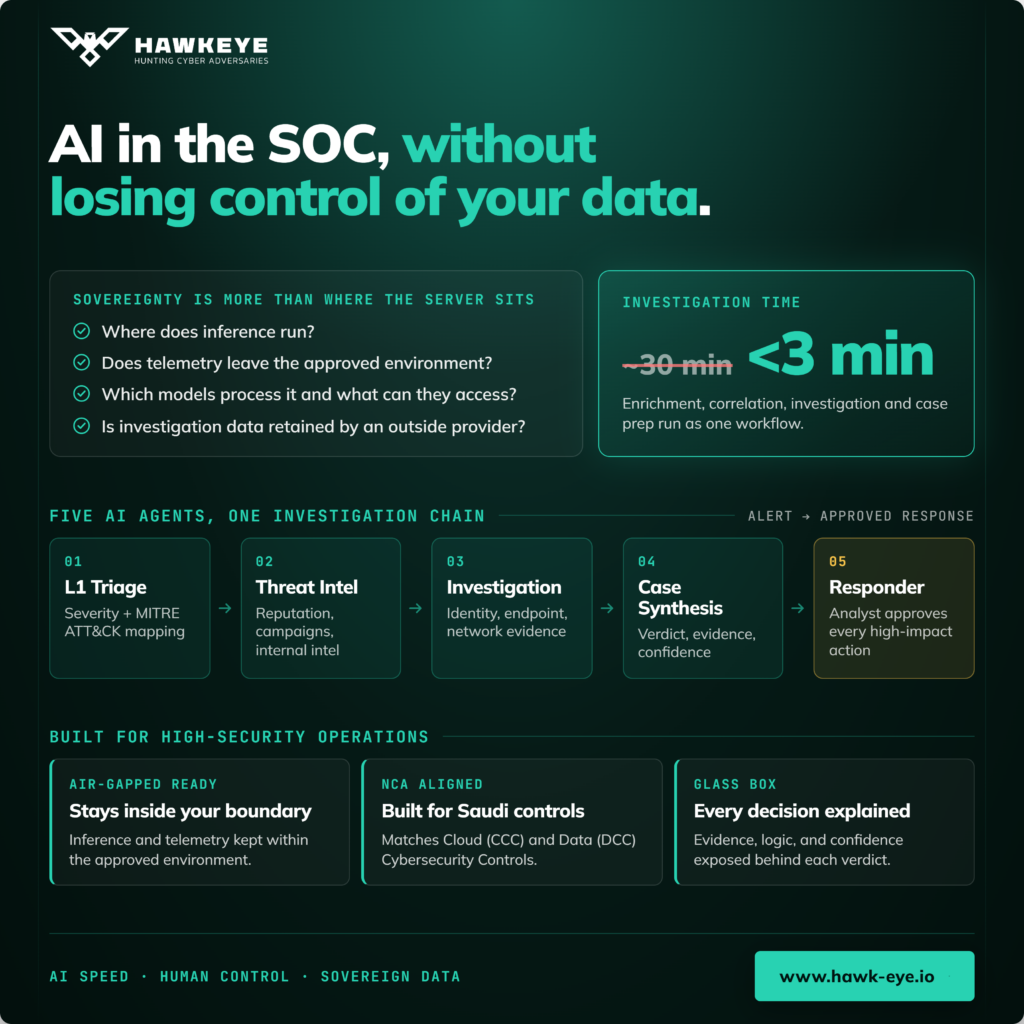
HawkEye’s AI SOC model is easier to understand when viewed as a sequence of SOC responsibilities.
L1 Triage: receives the alert, extracts observables, assesses severity, maps relevant activity to MITRE ATT&CK, and decides whether deeper investigation is required.
Threat Intelligence: enriches indicators with reputation data, known malicious infrastructure, campaign context, and available internal intelligence.
Investigation: examines the wider evidence around the alert. That can include process activity, authentication events, network connections, asset information, and other telemetry needed to reconstruct what happened.
Case synthesis: turns the findings into a concise investigation record with the verdict, evidence, confidence, and recommended next action.
Response coordination: prepares actions such as isolating an endpoint, blocking an IP address, disabling an account, or initiating additional forensic collection.
The final step is deliberately controlled.
HawkEye’s Responder does not execute high-impact actions independently. Analyst approval remains part of the workflow, and HawkEye exposes the evidence, logic, and confidence behind agent decisions through its Glass Box approach.
That design is particularly important in high-security environments where an incorrect containment action could disrupt production or affect critical services.
SIEM, SOAR, EDR, and Identity Data Need Shared Context
A major SOC problem has little to do with a shortage of security tools. The problem is that those tools often operate separately.
The SIEM generates the alert. EDR holds endpoint evidence. Identity systems contain authentication context. Threat intelligence sits in another platform. SOAR handles response. Analysts move between each system trying to assemble the same incident manually.
HawkEye is designed to bring that context into one investigation loop.
Alerts can be enriched, correlated, investigated, converted into cases, and moved toward response without requiring analysts to rebuild context at each stage. HawkEye Managed CSOC and XDR provides the broader security operations capability around that model, while DTS Solution’s Security Intelligence Operations practice supports SOC engineering, SIEM, XDR, threat hunting, DFIR, and security operations modernization.
DTS Solution already positions its Saudi practice around AI-powered cybersecurity for organizations operating in the Kingdom.
Sovereign AI SOC Is About Control, Not Simply Location
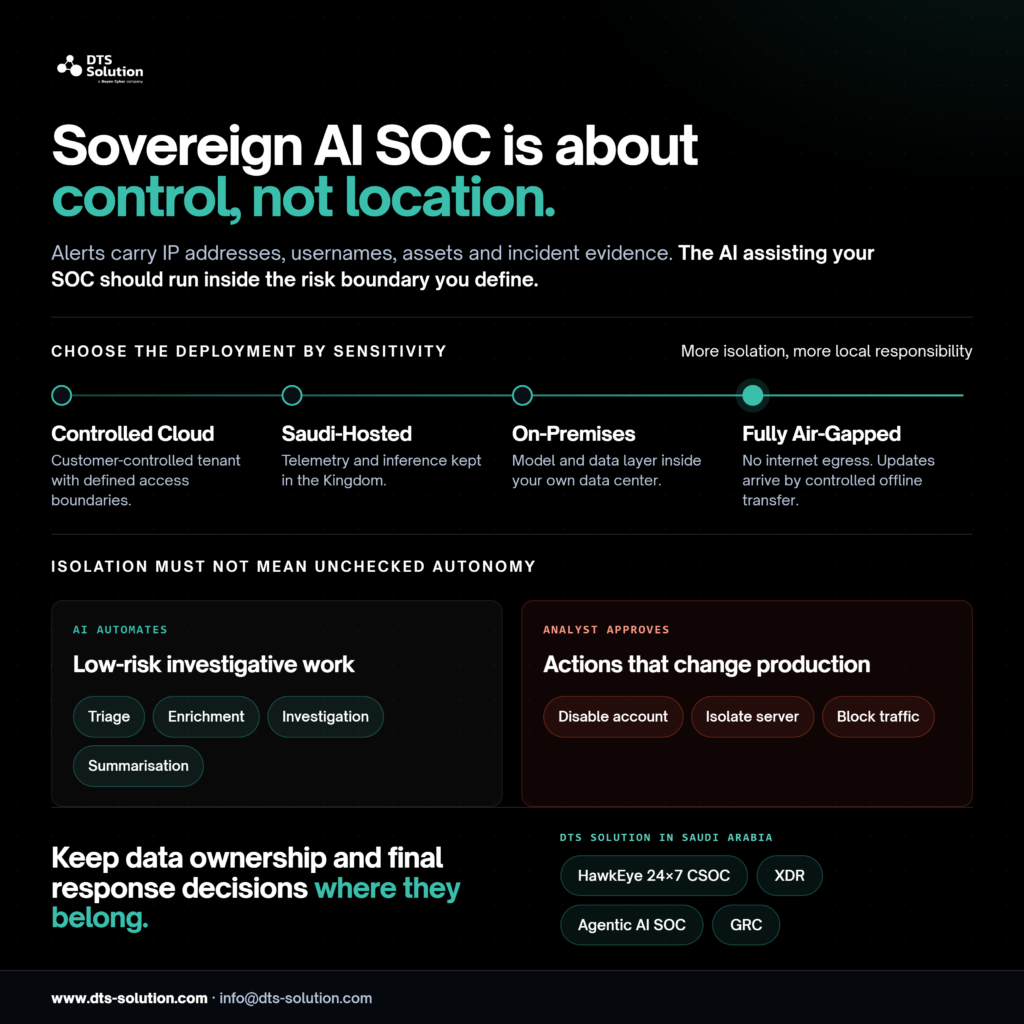
Data residency is one part of sovereignty, but it is not the whole architecture.
A sovereign AI SOC should allow the organization to control where security telemetry is stored, where model inference occurs, who can access the model, which systems the AI can query, how actions are approved, and whether information can leave the environment.
This distinction becomes important when AI is handling SOC data. Alerts may contain internal IP addresses, usernames, endpoint activity, authentication events, malware samples, asset information, vulnerabilities, and investigation notes. Sending that information to an external model introduces another processing path that security teams need to assess.
Recent sovereign SOC platforms are addressing this with local and air-gapped deployment models. Exotech, for example, recently announced expanded SOC AI capabilities in Saudi Arabia covering cloud, on-premises, hybrid, and fully air-gapped deployments, with human oversight retained for security decisions.
The wider principle is straightforward: the AI assisting the SOC should operate within the risk boundaries defined by the organization.
Air-Gapped Operations Create a Different SOC Problem
An air-gapped environment cannot depend on unrestricted external connectivity.
Security telemetry may be prohibited from leaving the network. Threat intelligence cannot always be queried directly from external sources. Model updates may require controlled transfer. AI agents may only be allowed to access an approved set of systems.
That changes the architecture required for an AI SOC.
The model runtime, investigation data, case records, and agent permissions need to remain within the approved boundary. External intelligence can be introduced through controlled processes where required. Model or detection updates may also need to follow offline validation and transfer procedures.
The important principle is that the AI workflow must adapt to the security boundary rather than forcing the security boundary to adapt to the AI.
This is especially relevant to Saudi enterprises operating sensitive infrastructure, industrial systems, restricted networks, or business environments where data sovereignty requirements rule out unrestricted external processing.
Sovereign Does Not Mean Autonomous
Running AI locally does not make unrestricted agent permissions safer.
An AI SOC still needs role-based access, service identities, tool restrictions, logging, approval controls, and clear limits on what each agent can do.
HawkEye’s human-in-the-loop model is useful here because investigation and execution remain separate. AI can conduct the repetitive investigative work at machine speed while analysts retain authority over actions with operational impact.
That balance matters in environments where the SOC must become faster without losing accountability.
Where DTS Solution and HawkEye Fit
DTS Solution in Saudi Arabia can help enterprises design the security operations architecture around the sensitivity of their systems rather than forcing every organization into the same deployment model.
The wider DTS capability covers SOC architecture, security engineering, detection, threat hunting, incident response, XDR, SIEM, and regulatory alignment. HawkEye provides the AI-driven operational layer that connects alert triage to investigation and controlled response.
The result is a more practical model for sovereign security operations: 100% alert investigation, faster case resolution, shared context across security tools, full evidence trails, and human control where actions can affect the business.
Saudi enterprises considering private, on-premises, or isolated AI security operations should begin with one question: where does the organization need AI speed, and where must control remain absolute?
HawkEye AI SOC is built around keeping both.