HawkEye AI Is Listed on SecOps Unpacked’s AI SOC Capability Map, Here’s What Backs It Up

The AI SOC market got crowded fast. Ask five vendors what makes their platform agentic or AI-powered and you’ll get five different answers, most of them marketing copy standing in for architecture. That’s the gap SecOps Unpacked was built to close: a research platform that maps the security operations vendor landscape by function, across categories like SIEM, SOAR, threat hunting, and detection engineering, rather than by whatever label a vendor’s homepage uses this quarter.
HawkEye AI is now listed on that map. The profile tags HawkEye across seven categories: AI SOC Capability, Data Analytics / UABA, SOAR, Threat Hunting, Threat Intel, Detection Engineering, and Data Ingestion & Processing. Here’s what sits behind that listing.
What the Listing Says
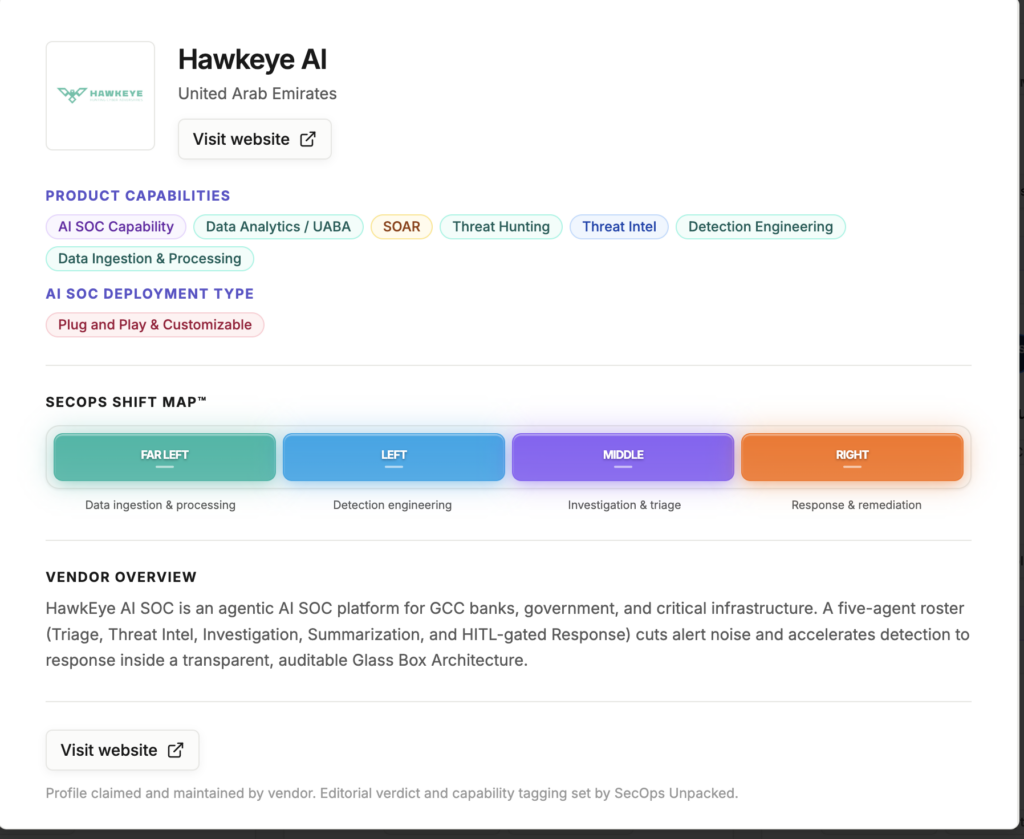
SecOps Unpacked’s own summary of HawkEye AI: an agentic AI SOC platform built for GCC banks, government, and critical infrastructure, running a five-agent roster (Triage, Threat Intel, Investigation, Summarization, and HITL-gated Response) inside a transparent, auditable Glass Box Architecture. The profile lists HawkEye’s deployment archetype as Plug and Play & Customizable, headquarters in the United Arab Emirates, and coverage across the platform’s own SecOps Shift Map: Data, Detection Engineering, Triage and Investigation, and Response.
That’s an accurate summary, and also the short version. Here’s the longer one.
Why Seven Categories, Not One
Most vendors mapped into AI SOC Capability earn that single tag and stop there. HawkEye’s profile also carries Data Analytics/UABA, SOAR, Threat Hunting, Threat Intel, and Detection Engineering, which tracks with how the platform is built: behavior baselining and anomaly detection under Data Analytics/UABA, purpose-built classifiers under Threat Intel and Detection Engineering, and the five-agent pipeline itself spanning Threat Hunting and response.
A single-category listing usually signals a point tool built for one job. A seven-category one signals a platform doing enough distinct work that a third party’s own taxonomy couldn’t fit it into one bucket.
What Backs Up the Listing
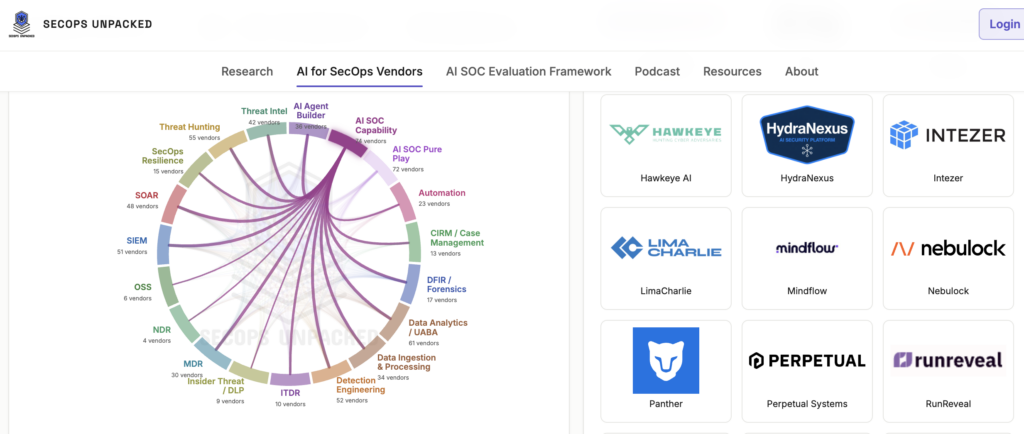
A category tag tells you where to start looking, not what you’ll find when you look. Here’s the architecture behind it:
- Five coordinated agents (L1 Triage Analyst, Threat Intel Analyst, Investigation Agent, Alert Summarizer, and Responder) that move an alert from raw indicator to documented verdict, covered in full in our companion post, “What Is an Agentic SOC?” (not yet published; link once live).
- Glass Box Architecture, meaning every verdict ships with a Decision Explainability writeup an analyst can read and challenge, not just a malicious or benign label.
- HITL-gated response, so the Responder agent stages actions but a human approves anything that isolates, blocks, or disables something in production.
- BYO-LLM, decoupling the reasoning model from a single provider so institutions can meet their own data residency requirements.
- Purpose-built machine learning underneath the agent layer, including behavior baselining and a deep learning classifier built to catch algorithmically generated malware domains, detailed in our companion post, “What Is an AI SOC?” (not yet published; link once live).
None of that shows up on a directory card. It’s the architecture the listing is pointing at.
Built for GCC Banks, Government, and Critical Infrastructure
Most vendors mapped into AI SOC Capability are building for a global, generalist buyer. HawkEye AI is built around the specific compliance realities of the region it serves: auditable decision trails for regulators like Saudi Arabia’s SAMA Cyber Security Framework, and entities in scope of the UAE’s Information Assurance Regulation, plus a BYO-LLM option that keeps the underlying model within whatever data residency boundary a GCC institution’s regulator expects.
That’s not a checkbox difference. It’s why a category listing built for a global audience is only the first filter, not the last one, for a bank or government entity evaluating AI SOC vendors in the Gulf specifically.
A Listing Is a Starting Point
Being mapped on SecOps Unpacked is a useful entry point for initial category research on AI SOC vendors. But a directory card can’t show a reasoning trace, and it can’t show what happens when an agent recommends blocking the wrong IP on a production banking system. Those are the things worth asking about directly, whichever vendors end up on your shortlist.