Social Engineering in the AI Age: How Offense Has Evolved and How to Defend

Social engineering has always worked because it targets the one component no firewall can patch, human judgment. What has changed is the speed, scale, and precision with which attackers can now exploit that judgment.
For decades, the tell-tale signs of a social engineering attempt were fairly consistent: awkward grammar, generic greetings, implausible urgency, and mismatched sender domains. Security awareness training was built around these signals. Employees learned to spot them. The model worked, imperfectly, but well enough.
That model is now breaking down.
Social Engineering Has Become More Personalized
One of the biggest shifts in recent years is the quality of impersonation.
Traditional phishing emails often relied on volume. Attackers sent thousands of generic messages, hoping a small percentage would succeed. AI-assisted social engineering changes that approach by improving personalization at scale.
Attackers can now analyze public profiles, company structures, executive communications, and employee activity rapidly to generate messages that resemble legitimate internal conversations. Emails mimic writing tone more convincingly. Messages reference actual projects, suppliers, or operational details. Requests appear more contextual and less random.
The result is that social engineering attacks are becoming harder to identify through traditional warning signs alone.
Many employees were trained to spot poor grammar, suspicious formatting, or generic language. Those indicators are becoming less reliable as AI-assisted content generation improves.
Deepfake and Voice Impersonation Risks Are Expanding
The threat is no longer limited to email.
Voice synthesis and deepfake technologies are introducing new forms of impersonation risk across organizations. Attackers can now imitate executives, suppliers, or internal personnel with a level of realism that creates operational pressure during real-time interactions.
This becomes especially dangerous in environments where urgency influences decision-making.
A phone call requesting a financial transfer, a voice note instructing a password reset, or a video message appearing to come from leadership can bypass traditional verification habits when employees are under pressure to act quickly.
These attacks are becoming increasingly difficult because they exploit human behavior rather than technical vulnerabilities.
The New Attack Patterns
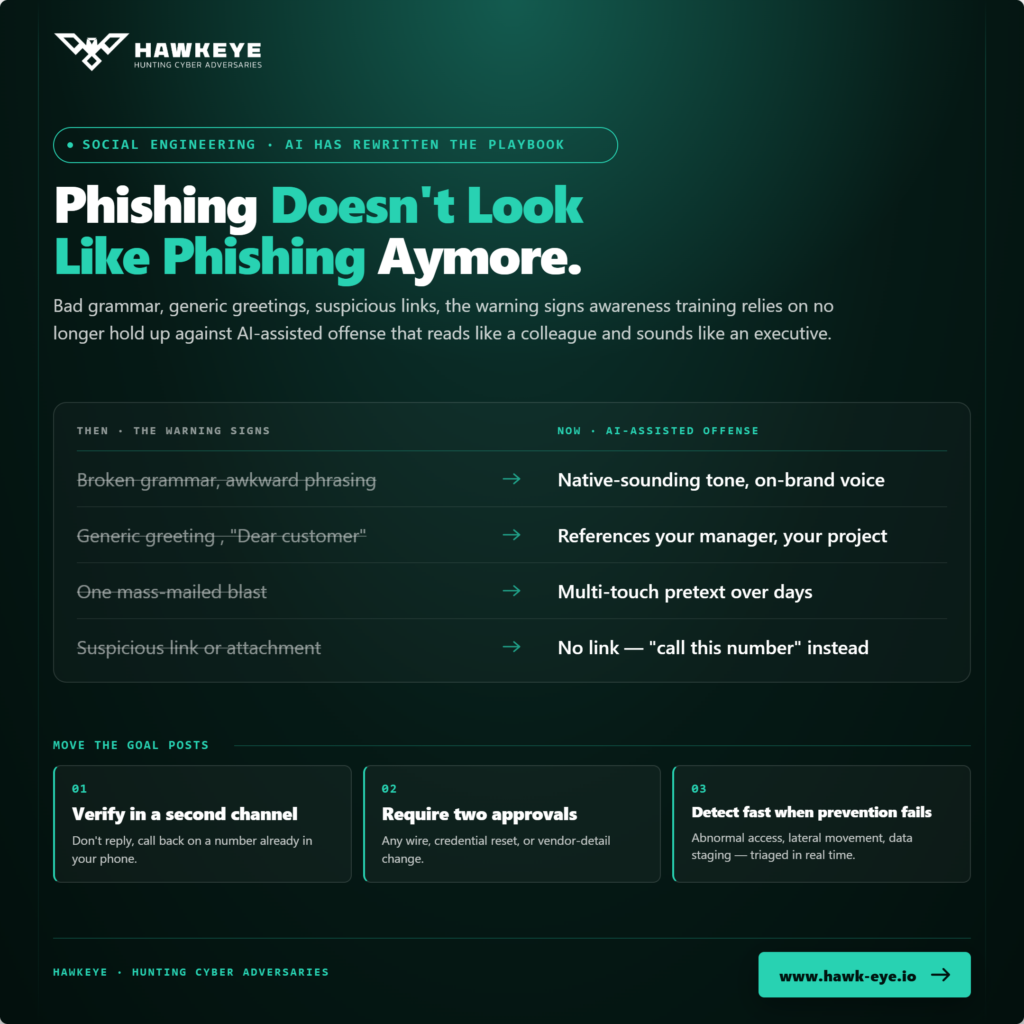
Three categories of AI-assisted social engineering are now showing up with regularity.
Hyper-personalized spear phishing. Rather than generic lures, attackers now build individual profiles from open-source data, job posts, press releases, social media, corporate websites and generate messages tailored to that specific person’s role, relationships, and recent activity. A message that references your actual manager, your current project, and the tool your team uses is far harder to dismiss than one that reads like a mass template.
Voice and video impersonation. Vishing (voice phishing) was already a growing attack vector before AI voice cloning. With cloning, attackers can now call employees impersonating a known executive, vendor, or colleague with a voice that matches closely enough to bypass suspicion. These calls often target payroll, finance, or IT helpdesk functions where a single interaction can have significant consequences.
Multi-stage pretexting campaigns. AI enables attackers to run longer, more patient deception campaigns. Rather than a single phishing email, they establish a relationship over multiple touchpoints a LinkedIn connection, a follow-up email, a phone call, each building credibility before the actual request. The final ask, when it comes, arrives after trust has been built.
Why Traditional Defenses Are Losing Ground
Awareness training built around “look for bad grammar” or “hover over links” remains useful but no longer sufficient on its own. Employees who have been trained to spot obvious tells may still fall for an attack that presents none of them.
Email filtering faces similar pressure. Filters that flag suspicious domains, analyze link destinations, or scan attachments were built against a different attack profile. A well-crafted phishing email with no malicious link, one that simply asks the recipient to call a number, clears most filters entirely.
The psychological levers attackers exploit, authority, urgency, fear, social proof, have not changed. What has changed is how convincingly those levers can now be pulled with minimal human effort on the attacker’s side.
Why Verification Processes Matter More Now
often prioritize speed over validation. Attackers exploit this pressure deliberately.As impersonation quality improves, organizations need stronger operational verification controls.
This includes validating sensitive requests through secondary communication channels, limiting approval authority for high-risk actions, and introducing stricter verification processes around financial transfers, credential changes, and privileged access requests.
Organizations relying heavily on trust-based workflows are becoming more exposed.
The challenge is balancing operational efficiency with verification discipline. In fast-moving environments, employees
A Layered Defense That Accounts for These Realities
No single control stops AI-assisted social engineering. The defense is a set of overlapping layers, each designed to catch what the others miss.
Redefine what users are trained to spot. Security awareness programs need to move beyond artifact-based detection (bad grammar, suspicious links) toward behavior-based skepticism. Train employees to verify unexpected requests through a second channel, if an executive emails asking for an urgent wire transfer, call them back on a number already in your phone. If a vendor calls requesting a change to payment details, verify through your existing contact record. The verification habit matters more than spotting the lure.
Harden the processes attackers target. Many social engineering attacks succeed because an internal process allows a single person to authorize a significant action. Wire transfers, credential resets, changes to payment information, and third-party access grants should all require multi-party authorization and out-of-band confirmation. Process hardening closes the door that the best awareness training alone cannot.
Monitor for the behavioral signals that precede a successful attack. AI-assisted social engineering campaigns often leave detectable traces before the final payload lands: unusual login attempts, access to resources outside normal patterns, account configuration changes, or communication with newly registered domains. Hawkeye’s AI SOC platform monitors these behavioral signals across your environment, correlating signals from identity systems, email gateways, and endpoints into a coherent investigation rather than isolated alerts.
Treat your high-value individuals as specific targets. Executives, finance teams, IT administrators, and anyone with privileged access or payment authority are disproportionately targeted. Run dedicated simulations against these groups. Assess what personal information about them is publicly available and work to reduce the open-source profile attackers can build. Consider additional verification requirements for any sensitive actions initiated through their accounts.
Detect compromise fast when prevention fails. Some attacks will succeed despite strong controls. The measure of your defense is not whether any attacker ever gets through, it’s how quickly you detect and contain the damage when one does. Hawkeye compresses detection-to-response time by automatically triaging the signals that follow a successful social engineering breach: abnormal access patterns, credential misuse, lateral movement, data staging. The faster that window closes, the less damage an attacker can cause.
The Underlying Problem
Social engineering succeeds because it bypasses technical controls by targeting people. AI has not changed that fundamental dynamic, it has made it faster, cheaper, and harder to detect visually.
The organizations that defend best against this are not those with the most sophisticated tools alone. They are the ones where verification culture is strong enough that employees ask a second question before acting, where processes require a second approval before money moves or access is granted, and where the security team gets a signal fast enough to intervene before a breach becomes a loss.