SIEM vs AI SOC Agent: What’s the Right Balance for Your Team?

A SIEM can tell your team that something happened. An AI SOC Agent can help explain whether it matters.
That difference is where many SOC teams are stuck. They have logs, alerts, dashboards, and correlation rules, yet analysts still spend hours checking context, enriching indicators, writing summaries, and deciding which events deserve escalation.
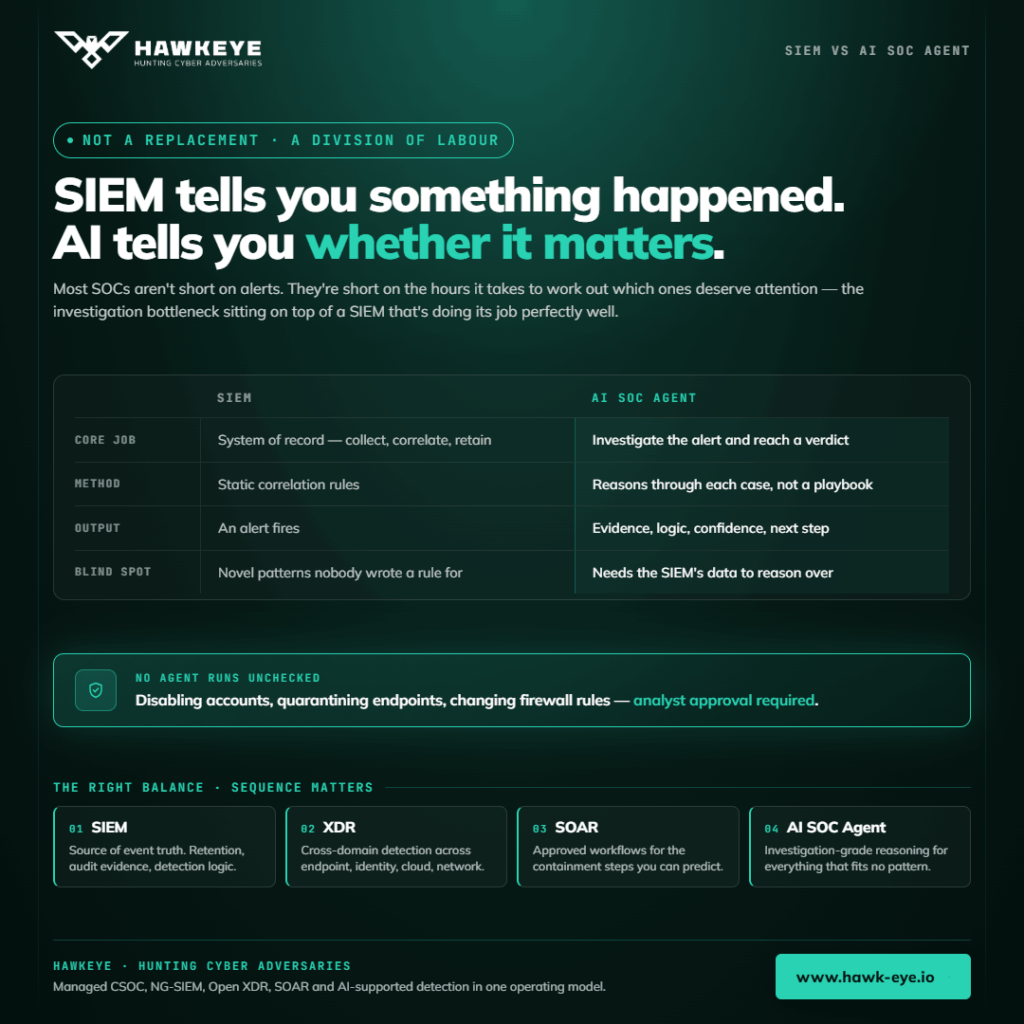
SIEM vs AI SOC Agent should not be treated as a replacement argument. A SIEM remains the system of record for security events, compliance evidence, and detection logic. An AI SOC Agent becomes useful when it reduces the manual work around alert triage, investigation, and response guidance.
What a SIEM Is Built to Do
A SIEM collects logs from firewalls, endpoints, identity systems, and cloud workloads, then correlates that data against rules to raise alerts. It’s the system of record for security operations, the place analysts search when they need history, and the place auditors look when they need proof of monitoring.
That role hasn’t gone away. Compliance frameworks still expect retained logs and demonstrable monitoring. Detection engineers still need a flexible platform to write and tune correlation logic for their specific environment. A SIEM gives you both.
Where it falls short is everything downstream of the alert. A SIEM tells you something happened. It doesn’t tell you whether that something matters, and it doesn’t do the digging required to find out. Rule-based detection also means coverage is only as good as the rules written for it, so novel attack patterns slip through until someone codifies them after the fact.
Where AI SOC Agents Fit In
An AI SOC agent picks up where the SIEM stops. Instead of matching an alert against a static rule and handing it to an analyst, it investigates, pulling related logs, checking identity and asset context, comparing the activity against known attack patterns, and building a case for whether the alert is a real threat or noise.
This matters most in the tier-one and tier-two grind: the hundreds of alerts a day that follow no fixed script but also don’t need a senior analyst’s full attention to resolve. An agent that can gather evidence and reach a defensible verdict in minutes changes what a SOC can keep up with, without adding headcount every time alert volume climbs.
The distinction from SOAR is worth making too. SOAR automates known workflows through playbooks, reliable for predictable scenarios, but it breaks down the moment an incident doesn’t match the script. An AI SOC agent reasons through each case instead of following one, which is why it holds up better against attack patterns nobody has written a playbook for yet.
No AI Agent Should Run Unchecked
Autonomy in the SOC needs limits. A good AI SOC Agent should show evidence, logic, confidence, and recommended actions. High-impact steps such as disabling accounts, quarantining endpoints, blocking business-critical traffic, or changing firewall rules should require analyst approval.
HawkEye’s Agentic AI SOC positioning follows this model. Its page describes five specialized agents for triage, enrichment, investigation, summarization, and staged response, with human approval required before response action is executed.
That is the safer balance: agents help speed up investigation, while humans retain control over actions that could affect operations.
The Mistake Teams Keep Making
Some vendors frame this as a replacement story, rip out the SIEM, let the agent take over. That framing doesn’t match how mature SOCs operate. A SIEM remains the foundation for data retention, compliance evidence, and detection engineering flexibility. An AI SOC agent doesn’t replace that foundation; it removes the investigation bottleneck sitting on top of it.
The organizations getting the most value are the ones treating the AI SOC agent as a force multiplier for their analysts, not a substitute for their SIEM. The SIEM keeps generating alerts and holding the historical record. The agent takes the alert, does the legwork a tier-two analyst would otherwise spend twenty minutes on, and hands the human a conclusion with the evidence behind it. Analysts spend their time on judgment calls and escalations instead of repetitive triage.
There’s a cost angle here too. Many SOCs quietly throttle their own detection coverage, tuning down alert volume not because the risk dropped, but because no one has time to triage everything the SIEM could generate. An agent that absorbs first-pass investigation lets teams turn detection back up without drowning the humans behind it.
Where HawkEye Fits
HawkEye CSOC and XDR is built around managed 24×7 security operations, NG-SIEM, UEBA, Open XDR, log correlation, deep analytics, and managed extended detection and response. For teams comparing SIEM and AI SOC Agents, that mix is important because security operations need both event visibility and response capability.
HawkEye AI adds AI-supported detection and response use cases across privileged activity, user behavior, network traffic, cyber threat intelligence, and anomaly detection. It is designed to reduce response time, improve prediction accuracy, and cut false positives.
That gives teams a more practical model: SIEM and XDR collect and correlate signals, AI helps enrich and prioritize them, analysts validate the decision, and response actions remain controlled.
Finding the Right Balance
The right mix depends on where your SOC hurts.
If your pain is compliance and visibility, regulatory log retention, audit evidence, a single search layer across a sprawling environment, your SIEM investment still carries the weight. Fix gaps in coverage before adding a new layer on top.
If your pain is investigation backlog, analysts drowning in alerts, MTTR climbing, skilled staff spending their day on tasks a script could do, that’s the gap an AI SOC agent is built to close. It sits on top of your existing SIEM, ingests what it already generates, and starts clearing the queue without a rip-and-replace project.
If your pain is response consistency, the same containment steps executed differently every time, that’s more a SOAR problem than either of the above, though a capable AI SOC agent can often absorb much of that work too, staging containment actions with the reasoning behind them for an analyst to approve.
Most SOCs need pieces of all three eventually. The sequencing matters more than the philosophy: get log visibility right, then automate the predictable response actions, then bring in investigation-grade reasoning for everything that doesn’t fit a fixed pattern.
Final Note
SIEM vs AI SOC Agent should not be framed as a winner-takes-all decision. SIEM remains the foundation for logs, correlation, audit evidence, and visibility. AI SOC Agents help security teams investigate faster, prioritize better, and reduce repetitive analyst work.
The right balance is simple: keep SIEM as the source of security event truth, use XDR for cross-domain detection, use SOAR for approved workflows, and use AI SOC Agents for investigation support with human control over critical actions.
For teams that need that balance without building every layer alone, HawkEye combines managed CSOC, XDR, AI-supported detection, SOAR, and analyst-led response into one operating model.