AI Threat Hunting: Finding What Detection Tools Already Missed

known malware, suspicious hashes, and obvious command execution. They are looking for weak signals across identity, cloud, endpoint, SaaS, network, and AI workloads before those signals turn into a confirmed incident. CrowdStrike’s 2026 Threat Hunting Report says AI is now embedded across modern adversary operations, with attackers using AI to generate payloads, abuse enterprise LLMs, exploit AI infrastructure, and increase the volume of activity defenders must investigate.
That changes what threat hunting needs to do. A hunt program cannot depend only on fixed rules and known indicators. It needs analysts who can ask better questions, data pipelines that can support deeper investigation, and AI that can connect related activity across systems faster than a human team working manually
Why Hunting and Detection Are Not the Same Thing
Detection waits for a known pattern to trigger an alert. Hunting starts from the opposite assumption: something has already slipped through, and the job is to find it before it causes damage. This distinction matters more each year, since attackers increasingly rely on identity abuse, living-off-the-land techniques, and novel tactics that a signature was never written to catch.
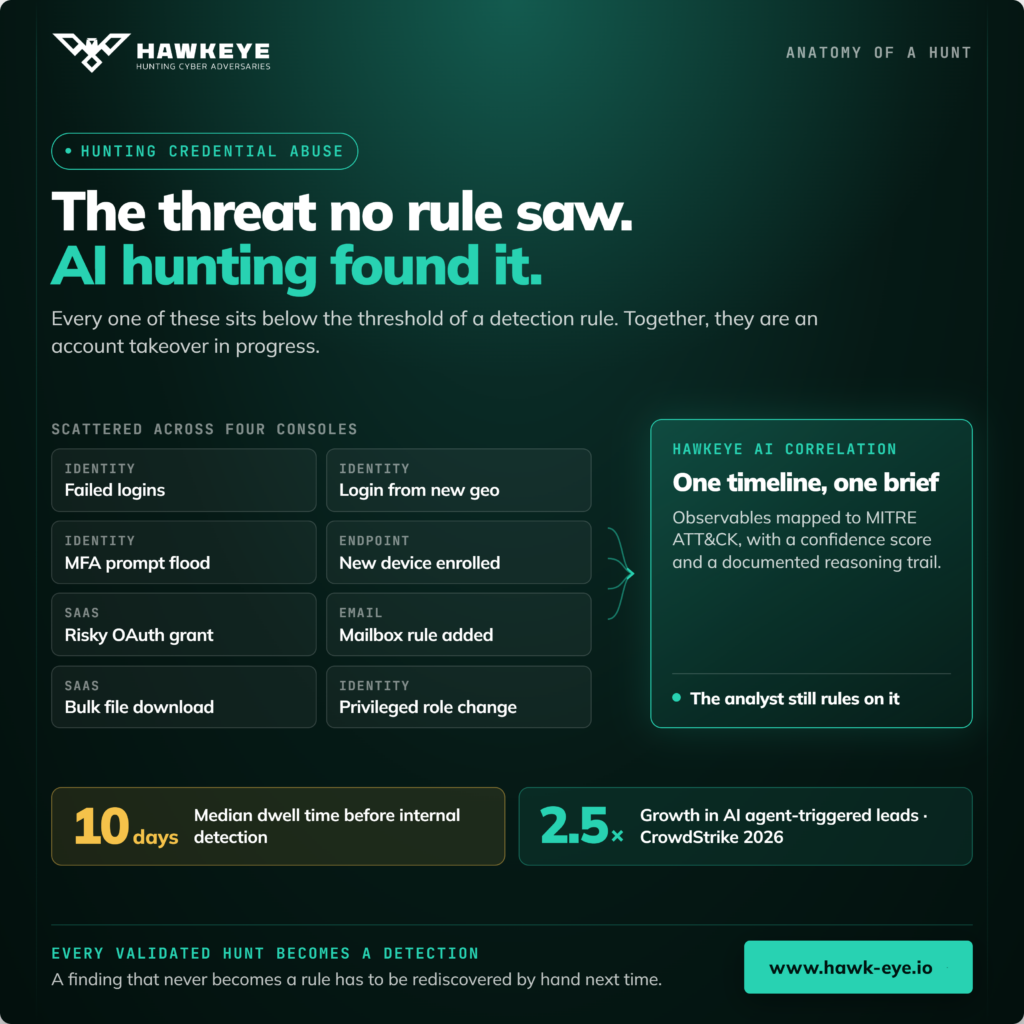
Recent industry dwell-time research puts the median time between compromise and internal detection at roughly ten days, a gap that gives an attacker ample room to move laterally, escalate privileges, and stage data for exfiltration before anyone reviewing a dashboard notices anything wrong.
Threat Hunting Has Moved Beyond Waiting for Alerts
Traditional detection works when the attacker does something that matches a rule. Threat hunting starts from a different place. It assumes something may already be wrong and looks for behavior that has not triggered a clear alert yet.
That distinction matters in 2026. Attackers are abusing trusted users, cloud roles, SaaS sessions, AI tools, developer workflows, and software supply chains. CrowdStrike reported that AI agent-triggered detection leads grew at 2.5x the rate of human-triggered leads, adding more activity for hunters to assess and making it harder to separate normal automation from malicious behavior.
AI threat hunting helps by reducing the manual burden. It can cluster related events, detect abnormal sequences, enrich observables, summarize timelines, and point analysts toward the activity that deserves review. The aim is not to remove human judgment. The aim is to give analysts a stronger starting point.
AI Threat Hunting Needs Strong Data
AI-driven hunting is only as good as the telemetry behind it. If endpoint logs are missing, cloud audit trails are incomplete, identity data is fragmented, or SaaS activity is not collected, the AI layer will struggle.
Security teams should start by checking their data coverage. Do they have logs from identity providers, EDR, cloud platforms, email security, firewalls, VPNs, DNS, SaaS applications, vulnerability tools, and privileged access systems? Can they correlate activity by user, device, application, asset owner, geography, and business function?
Without that foundation, AI can produce summaries, but it cannot produce reliable hunting insight.
This is why HawkEye CSOC and XDR is relevant to AI threat hunting. HawkEye’s managed CSOC and XDR service includes NG-SIEM, UEBA, Open XDR, security event correlation, managed extended detection and response, and threat hunting as a service.
The hunt layer becomes stronger when it sits on broad telemetry, not isolated alerts.
Where AI Helps the Hunter
AI is most useful when it accelerates the repetitive parts of hunting. It can group events from the same campaign, enrich IPs and domains, compare activity against known adversary tradecraft, translate raw logs into plain incident timelines, and highlight suspicious sequences across users or systems.
For example, an analyst may want to investigate possible credential abuse. AI can pull failed logins, successful logins from unusual locations, MFA prompts, new device registrations, risky OAuth grants, mailbox rule changes, SaaS downloads, and privileged role changes into one view. The human hunter then reviews the logic, checks business context, and decides whether the activity is malicious.
This balance matters. AI can reduce time spent switching between consoles. It can also reduce weak escalations caused by isolated alerts. Human analysts still own the conclusion.
HawkEye's Approach to Structured Hunting
HawkEye applies this exact division of labor through a layered agent model rather than a single generalized AI. A triage layer extracts observables and maps them to MITRE ATT&CK the moment an anomaly surfaces. A dedicated investigation layer queries logs, process trees, and network connections tied to the affected asset, reconstructing a timeline instead of leaving an analyst to piece one together manually. Findings then roll into a single synthesis brief carrying the evidence, a confidence score, and a documented reasoning trail, so a human reviewer can verify the logic rather than accept a verdict on faith.
This structure mirrors what mature hunting programs already value: speed on the mechanical steps, transparency on the reasoning, and a human making the final call before any consequential action gets taken. HawkEye’s AI-driven detection engineering is built specifically around this kind of continuous tuning, feeding validated hunts back into detection logic rather than treating each finding as a one-off investigation.
Building a Hunting Practice That Holds Up
Start with a hypothesis grounded in real intelligence. A hunt built around a recent CISA advisory or a newly added ATT&CK technique is far more likely to surface something real than a generic, unfocused search through logs.
Run long tail analysis on a schedule. Sorting recent process executions and authentications by rarity, rather than reviewing only what a SIEM already flagged, surfaces exactly the kind of activity signature detection is structurally unable to catch.
Feed every validated hunt back into detection. A finding that never becomes a rule has to be rediscovered manually the next time the same technique appears, which wastes the exact effort the hunt already spent.
Keep a human on verdict authority for novel findings. Speed matters, but a fully automated conclusion on an unfamiliar pattern is where autonomous systems consistently underperform a trained analyst.
Track dismissed alerts as closely as confirmed ones. A high dismissal rate often signals alert fatigue rather than genuine noise, and the true positives buried inside that pile are usually what a structured hunt is built to find.
Conclusion
AI Threat Hunting is not about replacing analysts with automation. It is about giving analysts the speed, context, and correlation needed to find attacker behavior earlier.
The strongest teams will combine human hypothesis-driven hunting with AI-assisted enrichment, entity behavior analytics, XDR telemetry, threat intelligence, and clear response workflows.
For organizations using HawkEye, the model is practical: HawkEye AI helps surface behavioral signals and reduce noise, while HawkEye CSOC and XDR gives teams the managed detection, threat hunting, correlation, and response foundation needed to act on those signals.
The goal is simple: stop waiting for the perfect alert. Hunt for the behavior that tells you the attack has already started.