Agentic Detection and Response: The Security Layer AI Agents Now Need

Agentic Detection and Response, or ADR, is becoming necessary because AI agents are no longer limited to chat windows. They are calling APIs, querying databases, writing code, using tools, handling workflows, and making decisions at machine speed. The security problem is direct: most SOC tools were built to monitor users, endpoints, servers, cloud workloads, and networks. They were not built to watch a non-human agent reason, choose a tool, call a function, access data, and take action.
That gap creates a new control problem for CISOs and security teams. If an AI agent can act, it needs identity, monitoring, policy enforcement, behavioral baselines, and response controls. Without that, the organization is giving automated workers access without the visibility normally required for human users or service accounts.
ADR Starts Where Traditional Monitoring Stops
Endpoint Detection and Response can show file activity, process behavior, and device-level signals. SIEM can collect logs and correlate events. XDR can connect endpoint, identity, cloud, and network telemetry. Those layers still matter, but AI agents create activity at another layer: prompts, tool calls, execution traces, model decisions, plugins, MCP tools, and agent-to-system actions.
A 2026 ADR research paper describes three persistent problems in securing enterprise AI agents: limited observability, weak robustness from static defenses, and high detection cost when LLM-based review is used at scale. The paper frames ADR as an enterprise system for securing AI agents using observability, benchmarking, and threat detection.
That is the reason ADR exists. It gives the SOC visibility into what the agent is doing, not only what the endpoint or application logs happen to show afterward.
What ADR Monitors
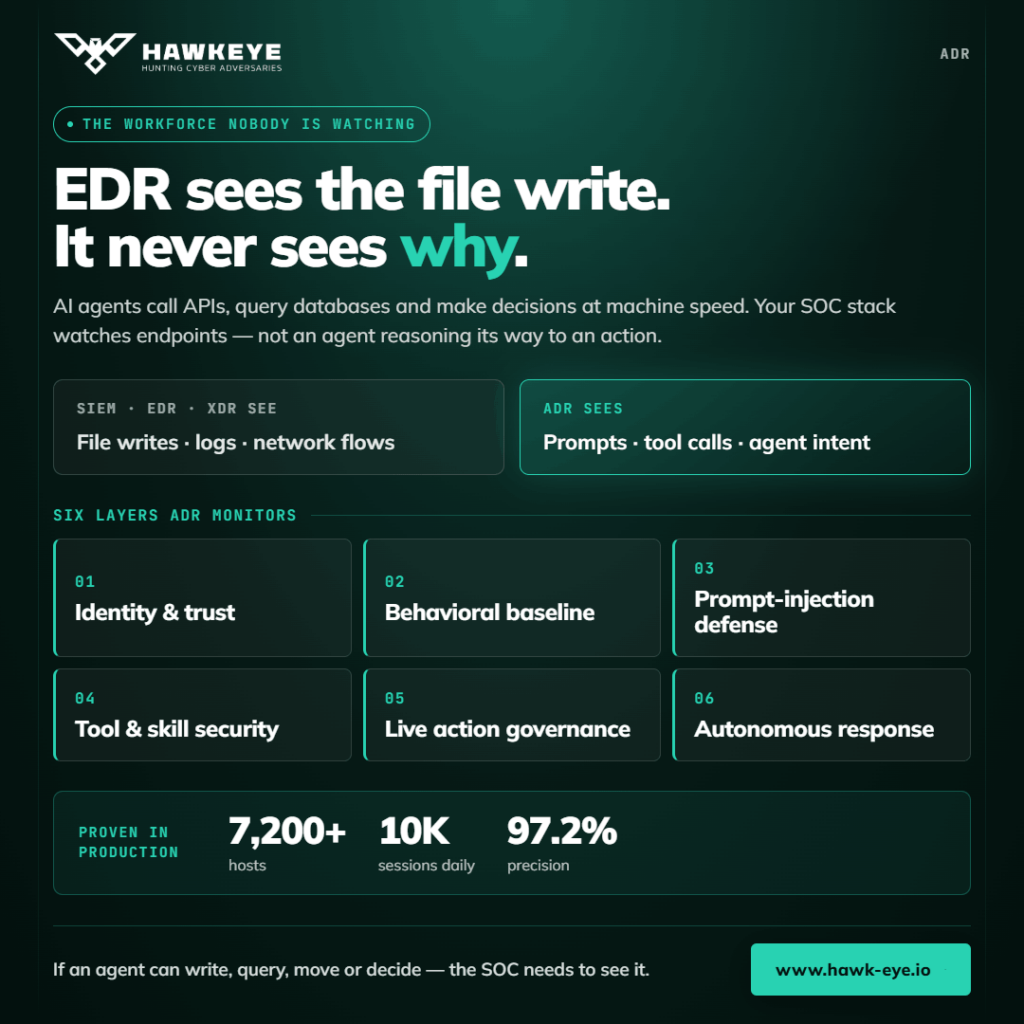
A working ADR deployment covers six distinct layers of agent activity.
Identity and trust gives every non-human identity a certificate and a live trust score. No certificate, no action. This turns agent identity from an assumption into something enforced.
Behavioral fingerprinting establishes what “normal” looks like for each individual agent, then flags drift the moment it happens: new tools invoked, new data paths touched, new targets contacted.
Prompt-injection and jailbreak defense detects inbound manipulation inline, with pre-execution hardening applied to an agent’s system prompt against known attack patterns before it ever runs.
Skills and tool security scans every plugin, skill, and MCP tool an agent loads for malicious code, poisoned dependencies, and known indicators of compromise. The next supply-chain attack is far more likely to target an agent’s tool chain than a laptop.
Live action governance risk-scores every tool call, query, API hit, file write, and decision an agent makes in real time against policy.
Autonomous response quarantines an agent the moment it turns, revoking its identity or escalating to a human for validation, before a single bad action becomes a breach.
Why This Category Is Not Theoretical
Independent research backs up why this layer matters. Uber’s own production deployment of an agentic detection system ran for over ten months across more than 7,200 hosts, processing upwards of 10,000 agent sessions daily. It surfaced hundreds of credential exposures across 26 categories, catching them with 97.2 percent precision. The paper is explicit about why existing tools miss this: traditional endpoint detection and response sees file writes, not the reasoning, prompts, or causal chain linking an agent’s intent to what it executed.
That distinction is the entire point of ADR as a category. An EDR agent watching a laptop was never built to understand why an AI agent decided to query a database, escalate a permission, or exfiltrate a file. ADR is built specifically to answer that question.
The Five Agents Behind HawkEye AI SOC
HawkEye uses five specialized agents across the SOC workflow: L1 Triage, Threat Intel, Investigation, Alert Summarizer, and Responder. Each agent owns a defined part of the workflow, which keeps the process structured instead of relying on one general-purpose AI layer to handle everything.
- L1 Triage Analyst
This agent is the first filter for incoming alerts. It parses alert payloads, extracts observables, maps activity to MITRE ATT&CK, scores severity, and decides whether the alert should be escalated, monitored, or suppressed. HawkEye’s AI SOC positioning describes this role as the first eyes on every alert, built to reduce the manual queue before an analyst touches the case. - Threat Intel Analyst
This agent enriches indicators of compromise with reputation, campaign context, and attribution signals. It checks sources such as VirusTotal, MISP, and HawkEye’s internal CTI platform, then passes richer context to the next stage of investigation. That matters because raw IOCs rarely tell the full story on their own. - Investigation Agent
This agent performs deeper investigation. It queries logs, process trees, sessions, network connections, and related asset activity. Its role is to reconstruct the timeline, surface lateral movement, and show whether an alert is isolated or part of a wider attack chain. - Alert Summarizer
This agent turns the investigation into an analyst-ready brief. It rolls up the verdict, key evidence, confidence score, and recommended next steps. For SOC teams, this reduces the time lost to writing case notes and helps senior analysts review incidents faster. - Responder
This agent stages the response. It can recommend containment, escalation, or workflow actions, but response should remain controlled. HawkEye’s AI SOC model emphasizes analyst approval, which is important because security automation must not create business disruption through unchecked action.
The value of the five-agent model is separation of responsibility. Triage does not do the work of threat intelligence. Investigation does not write the final brief alone. Response does not fire without review. Each agent handles a defined task, while the SOC keeps visibility over the reasoning, evidence, confidence, and next step.
Where HawkEye Fits
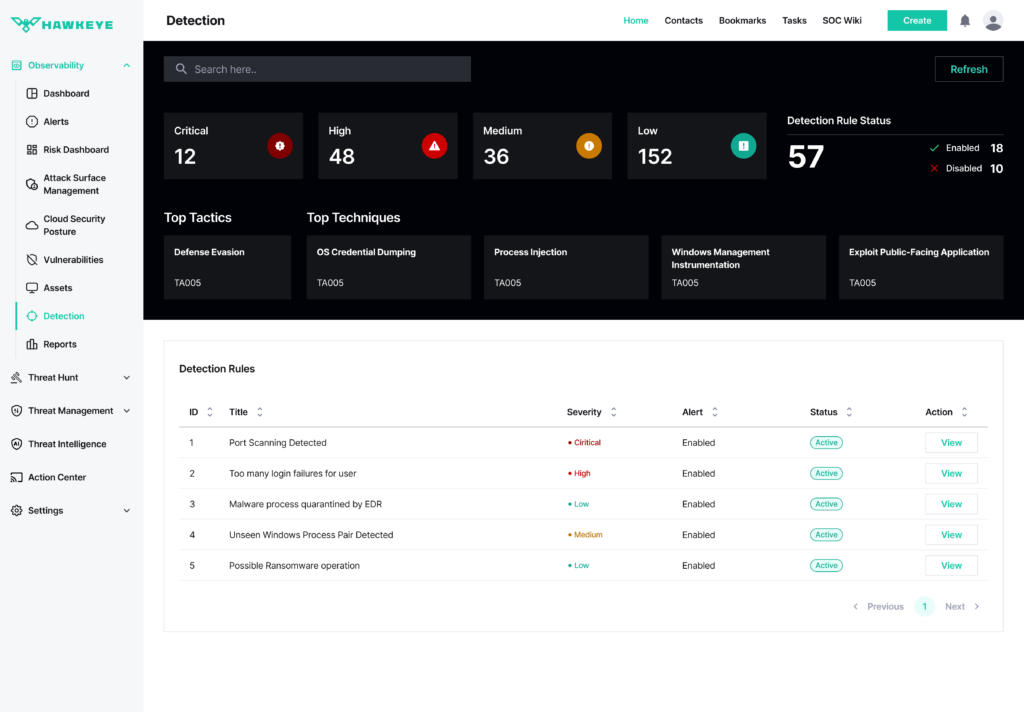
HawkEye AI SOC brings agentic investigation into the security operations workflow. Its five-agent structure helps SOC teams move from raw alerts to enriched, investigated, summarized, and response-ready cases with analyst oversight.
HawkEye CSOC and XDR gives organizations a managed 24/7 SOC and XDR foundation for event correlation, deep analytics, detection, and response. ADR extends that model into the AI agent layer, where the SOC needs visibility into agent identities, actions, prompts, skills, policies, and behavior.
For organizations adopting agents across coding, finance, HR, customer support, security, and operations, this combination matters. CSOC and XDR monitor the enterprise. AI SOC agents help investigate enterprise alerts. ADR watches the non-human workforce acting across those systems.
Building an ADR Program
Inventory every agent first. Most organizations cannot answer how many AI agents are currently running against their systems, let alone what each one is authorized to touch. This inventory is the same starting point traditional asset management requires, applied to a non-human population.
Instrument the control plane, not just the prompt layer. A lightweight SDK dropped into major frameworks such as LangChain, CrewAI, AutoGen, LlamaIndex, and various assistant platforms makes every agent action visible, scored, and governable from the moment it deploys.
Establish trust scoring before an incident forces the question. Waiting until an agent has already caused damage to define what “normal” behavior looks like means starting the investigation with no baseline to compare against.
Treat agent tool loading as a supply chain risk. Every skill or plugin an agent pulls in deserves the same scrutiny as a third-party software dependency, since it carries the same category of risk.
HawkEye ADR applies exactly this model: a SOC-as-a-Service purpose-built for the non-human workforce, layering identity, behavior, prompt defense, tool security, governance, and autonomous response into a single operating system for AI agents. The broader HawkEye AI platform this is built on already applies the same behavioral and pattern-matching approach across human-driven environments, extended here to cover agents specifically.
Conclusion
Agentic Detection and Response is not a replacement for SIEM, XDR, EDR, or SOC operations. It is the missing layer for AI agents that can act across business systems.
The right model is simple: give every agent an identity, monitor every action, baseline normal behavior, scan every tool, enforce policy at runtime, and respond when an agent breaks trust.
AI agents may become part of daily enterprise work, but they should never become invisible operators. If they can write, query, move, decide, or execute, the SOC needs to see them.