Choosing the Reasoning Model for Your AI SOC

Public model leaderboards measure general reasoning on public benchmarks. None of them measure whether a model reaches the right verdict on your alerts, in your environment, with your asset context attached. A model that tops a general leaderboard can still be the wrong choice for a SOC, and the gap between the two measures is where most model-selection decisions go wrong.
There is a second reason the leaderboard answer fails. In a regulated GCC institution, the question is never only which model reasons best. It is which model can reason over identity logs and endpoint telemetry inside the jurisdiction SAMA’s Cyber Security Framework or the UAE’s Information Assurance Regulation expects them to stay in. A model that cannot be hosted in-region is not a candidate, whatever it scores.
Different Agents Want Different Models
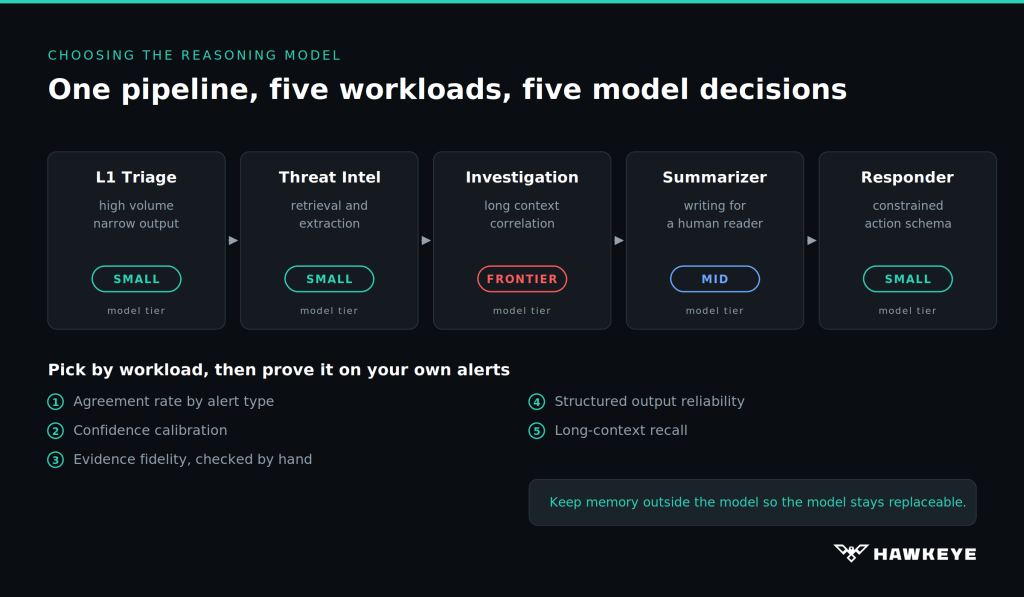
The assumption behind a single model choice is that a SOC makes one kind of inference. It does not. The five agents in a multi-agent pipeline have measurably different workloads, and matching the model to the workload is both cheaper and more accurate than routing everything to one engine.
- L1 Triage Analyst: high volume, narrow decision space, structured output. A smaller, faster model with strong instruction following handles this well, and the volume makes the cost difference material.
- Threat Intel Analyst: mostly retrieval and summarization over feed responses. Accuracy on structured extraction matters more than deep reasoning.
- Investigation Agent: long-context, multi-source correlation, hypothesis formation. This is the step where a frontier model earns its price, because the failure mode of a weaker model here is a missed link rather than a clumsy sentence.
- Alert Summarizer: writing quality for a human reader. A mid-tier model is usually sufficient, since the facts are already settled by the time this step runs.
- Responder: constrained output mapped to an action schema. Reliability and format adherence matter far more than eloquence.
This is what BYO-LLM is for in practice. A platform where the model is a configuration value per agent, rather than a vendor decision, lets the institution tune cost and accuracy independently at each step. HawkEye’s AI SOC is built this way for that reason.
The Five Tests to Run on Your Own Alerts
A model evaluation that uses public benchmarks is testing a different question than the one you are asking. Run these instead, on one week of your own alerts, with the candidate models swapped behind the same agent pipeline.
- Agreement rate: how often the verdict matches what your analysts concluded on the same alerts, broken down by alert type rather than averaged.
- Calibration: whether stated confidence tracks correctness. A model that is 90 percent confident and 60 percent right is more dangerous than one that is consistently uncertain, because the gate releases actions on confidence.
- Evidence fidelity: whether the reasoning trace cites evidence that exists. Check a sample by hand. A model that fabricates a plausible enrichment result has produced an unusable trace, regardless of the verdict.
- Format reliability: how often the structured output parses on the first attempt. Retries cost money and latency, and a model that drifts on schema will silently break the Responder.
- Long-context recall: whether a detail placed in the middle of a large evidence bundle is used in the conclusion. This is where real investigations fail and where general benchmarks are least informative.
Why the Model Has to Be Replaceable
Model releases move faster than procurement cycles. CrowdStrike’s 2026 Global Threat Report recorded AI-enabled adversary activity up 89 percent year over year, a pace HawkEye’s threat advisories track week to week. A SOC architecture that hard-codes one model vendor inherits that vendor’s roadmap, pricing, and regional availability as constraints on its own defense.
Replaceability has one architectural precondition. The institutional knowledge has to live outside the model, in a memory layer the SOC owns, so that swapping the engine does not discard a year of case history and analyst corrections. A platform that fine-tunes your data into a vendor-hosted model has made the swap expensive by design.
One operational requirement follows from the same point. The reasoning trace for every verdict has to record which model produced it. When the model changes, you need to answer which verdicts the previous one made without re-running them.
Building the Golden Set
Every test in the previous section needs a fixed sample to run against. Build it once and the whole evaluation becomes repeatable for every future candidate, which is what turns model selection from a project into a routine.
- Stratify rather than sample randomly: take a fixed number of alerts from each alert type you receive in volume, so a model cannot score well by being good at the one type that dominates your queue.
- Include the awkward classes deliberately: known false positives your team recognizes on sight, alerts that were escalated and turned out benign, and the handful of confirmed incidents you have. A set made only of clean cases measures nothing useful.
- Label from analyst disposition, not from the original severity: the ground truth is what a person concluded after investigating, which is the only label worth comparing a model against.
- Freeze it and keep it out of any tuning loop: a golden set that gets used to adjust prompts stops being an independent measure. Keep a separate development set for that.
- Redact to the level that lets you share it: if the set can be run against a hosted candidate without exposing identifiable internal detail, your options stay open.
Measuring Calibration Properly
Calibration is the test teams skip because it sounds academic. It is the most operationally important one on the list, because the approval gate releases actions on confidence, and an overconfident model silently widens what runs unattended.
The measurement is simple. Bucket every verdict in the golden set by its stated confidence, then compare the stated confidence to the observed accuracy within each bucket.
confidence 0.90 to 1.00 -> verdicts: 240 correct: 178 observed: 0.74
confidence 0.70 to 0.89 -> verdicts: 310 correct: 242 observed: 0.78
confidence 0.50 to 0.69 -> verdicts: 190 correct: 131 observed: 0.69
The figures above are illustrative, not measured. What matters is the shape. A well-calibrated model produces observed accuracy close to the stated band in every row. The first row in that example is the dangerous one, because any policy rule that auto-releases an action above 0.90 confidence is running on an assumption the model does not support.
This has a direct policy consequence. Set the auto-release threshold from the observed accuracy in your own calibration table rather than from the confidence number the model reports, and re-measure it whenever the model changes.
Designing the Long-Context Test
Real investigations put the decisive fact somewhere in the middle of a large evidence bundle, which is the position models handle worst and public benchmarks test least.
Construct the test from your own closed cases. Take a case where one specific observation drove the verdict, such as a forwarding rule created after a login. Rebuild the evidence bundle with that observation placed at the start, then at the middle, then near the end, and run each version. A model that reaches the right verdict only when the fact sits near the edges of the context will quietly miss cases in production, and it will miss them with high confidence because nothing in its input told it something was absent.
Frequently Asked Questions about AI SOC Cost
What is the best LLM for a SOC?
There is no single answer that survives contact with a real environment. The right model differs per agent role, and the only evidence that matters is agreement rate and calibration on your own alerts. Public leaderboards measure general reasoning, not verdict quality on your telemetry.
What does BYO-LLM mean in an AI SOC?
It means the reasoning model is a configuration choice rather than a fixed part of the platform, so the institution can host it where its regulator requires, swap it as better models appear, and tune cost per agent role. For GCC banks and government entities it is usually a data residency requirement before it is a cost or quality decision.
Should an AI SOC fine-tune a model on our security data?
Rarely, and it carries a cost most buyers do not price. Fine-tuning locks institutional knowledge inside a specific model, which makes future model changes expensive. Keeping that knowledge in a retrieval layer the SOC owns delivers the same context benefit and leaves the model replaceable.
How often should the reasoning model be re-evaluated?
Whenever a materially better or cheaper candidate becomes available in your hosting region, and on a fixed cadence regardless. The eval harness is the reusable asset. Once the five tests run against your own alerts, re-running them for a new candidate is a short exercise rather than a project.