CVE-2026-20700: Apple Patches Zero-Day Exploited in Sophisticated Cyber Attacks

When Apple pushes an emergency patch and references an “extremely sophisticated attack” in the same breath, it’s worth stopping to pay attention. CVE-2026-20700 is the first actively exploited zero-day of 2026, and it was already being used against real targets before a fix existed. The flaw lives in dyld, Apple’s Dynamic Link Editor, a foundational component across every Apple operating system, meaning iPhones, iPads, Macs, Apple Watches, Apple TVs, and Vision Pro devices are all in scope.
What sets this apart from a routine patch is who found it and how it was used. Google’s Threat Analysis Group, the team that tracks government-backed hackers, reported the vulnerability to Apple alongside two additional WebKit flaws, pointing to a deliberate exploit chain rather than a standalone bug. The targets were specific individuals, which in threat intelligence terms reads as a surveillance operation, not an opportunistic crime. That context matters when deciding how urgently to act.
What Is CVE-2026-20700?
CVE-2026-20700 is a memory corruption vulnerability that carries a CVSS score of 7.8. It resides in dyld, the core system component responsible for loading and linking shared libraries when applications launch on Apple platforms. An attacker who already holds memory write access on a vulnerable device can exploit this flaw to achieve arbitrary code execution, essentially gaining the ability to run any code of their choosing on the affected system.
Apple confirmed in its advisory that the issue may have been exploited in an “extremely sophisticated attack” against specific targeted individuals on versions of iOS before iOS 26. The attack profile, combined with the fact that it was reported by Google’s Threat Analysis Group (TAG), a team dedicated to tracking state-sponsored and advanced persistent threats — strongly suggests the involvement of commercial spyware or nation-state actors.
Two companion vulnerabilities, CVE-2025-14174 and CVE-2025-43529, were disclosed alongside CVE-2026-20700 as part of the same report. Both affect WebKit, Apple’s browser engine, and were also credited to Google TAG. The full scope of how these three vulnerabilities were chained together in the wild has not yet been publicly disclosed.
Affected Platforms and Available Fixes
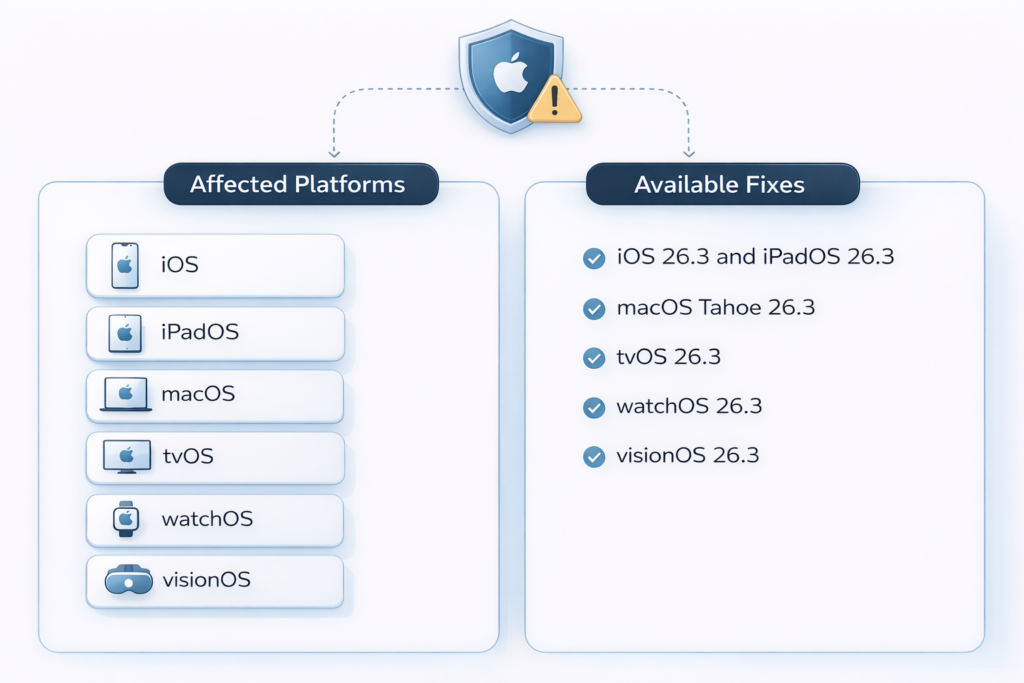
The vulnerability affects iOS, iPadOS, macOS, tvOS, watchOS, and visionOS. Apple has released patches across its current OS branches:
- iOS 26.3 and iPadOS 26.3
- macOS Tahoe 26.3
- tvOS 26.3
- watchOS 26.3
- visionOS 26.3
Users running older branches, including iOS 18.7.5, iPadOS 18.7.5, macOS Sequoia 15.7.4, and macOS Sonoma 14.8.4, are awaiting backported fixes. Apple has indicated these will follow, but timing remains unconfirmed. Regardless of whether the attacks have been described as targeted, all Apple users are strongly encouraged to apply available updates immediately.
CISA Steps In
The U.S. Cybersecurity and Infrastructure Security Agency (CISA) added CVE-2026-20700 to its Known Exploited Vulnerabilities (KEV) catalog, mandating that Federal Civilian Executive Branch (FCEB) agencies remediate the vulnerability by March 5, 2026. This formal inclusion signals that the flaw poses a credible, confirmed risk beyond theoretical exploitation.
CISA simultaneously added three other vulnerabilities to the KEV catalog around the same time. These include CVE-2025-15556, a flaw in Notepad++ that a China-linked threat actor known as Lotus Blossom abused to deliver a previously unknown backdoor called Chrysalis through a compromised update pipeline. Also added were CVE-2025-40536, a security control bypass in SolarWinds Web Help Desk, and CVE-2024-43468, a critical SQL injection vulnerability in Microsoft Configuration Manager carrying a CVSS score of 9.8. The clustering of these additions within the same advisory window underscores the breadth of active exploitation organizations are currently contending with.
Why This Zero-Day Matters Beyond Apple
This vulnerability is particularly significant for a few reasons. First, the involvement of Google TAG in its discovery places it firmly within the category of high-sophistication attacks, typically associated with surveillance operations or espionage. Flaws of this nature are rarely deployed carelessly; they tend to be used selectively against journalists, dissidents, executives, and government officials.
Second, CVE-2026-20700 is a zero-day, meaning it was being exploited before Apple had a fix available. There was no window for defenders to patch before real attacks occurred. This is a stark reminder that even the most tightly controlled ecosystems are not immune to targeted intrusions.
Third, the attack chain likely extended beyond this single flaw. The concurrent disclosure of two WebKit vulnerabilities suggests that attackers combined multiple exploit primitives to achieve a complete device compromise, a technique commonly associated with commercial spyware vendors whose products have appeared in high-profile cases in recent years.
What Organizations Should Do Now
Any organization running Apple devices, whether corporate-managed iPhones, MacBooks, or shared devices, should treat this patch as a priority. Verify that managed devices are updated to the patched OS versions, and confirm that older branches have received or will imminently receive the backported fix.
Beyond the immediate patch, this incident highlights the value of continuous exposure management. Knowing which devices in your environment are running outdated OS versions, which are internet-exposed, and which are managed versus unmanaged is foundational to responding quickly when a zero-day surfaces. Having deep integrations across your asset inventory makes it possible to identify unpatched devices and prioritize remediation before exploitation takes hold.
For organizations with high-value targets, executives, legal teams, or personnel handling sensitive data, the targeted nature of these attacks adds particular urgency. Spyware campaigns historically begin with a small number of high-value victims and expand as attackers establish footholds and pivot. Catching anomalous behavior before a foothold becomes a full compromise is exactly where continuous, AI-driven monitoring earns its keep, correlating signals across your attack surface to surface threats that would otherwise go unnoticed until it’s too late.
Conclusion
CVE-2026-20700 is a textbook example of why zero-day advisories tied to Google TAG disclosures demand immediate attention, not routine patch scheduling. The sophistication of the reported attack, the breadth of affected Apple platforms, and the concurrent exploitation activity across SolarWinds, Notepad++, and BeyondTrust all point to a threat environment where defenders have very little margin for delay.
Update your Apple devices. Audit your patch coverage. And make sure you have the visibility in place to know exactly what’s running in your environment before the next zero-day lands.